press kit + launch command
Everything a launch day needs,
in one place, pre-counted.
copy blocks are character-audited against product hunt's limits. assets were painted by the app's own renderer from real fleet data — the same engine behind the og cards.
identity
product name
AXON
tagline
Live telemetry for AI agents — spans, spend, failures
short description
AXON turns any AI agent into a glass box. One POST per operation — spans, tokens, latency, dollars, failures — and your whole fleet becomes a living dashboard: trace waterfalls that build in real time, token burn per model, p95 latency, and a burn meter that flags a bad deploy within 15 minutes. No SDK, no signup, no framework lock-in. Postgres-native and self-hostable. The demo is honest: it streams a clearly-labeled simulated fleet right now, and one curl puts your own agent on it.
maker story (first-person, adapt freely)
Two months ago my agent looped. A flaky search tool retried in a retry of a retry, and by morning it had spent $311 across three models — and I found out from the invoice, not from my tooling. Every observability tool I reached for was built for requests, not runs: no parent-child span tree, no cost per model decision, no "which exact step set the money on fire." So I built the thing I wanted at 2 a.m.: a spine, not a platform. AXON is two Postgres tables and one HTTP endpoint. Agents POST spans; AXON rolls them into runs with tokens, cost and failure state; the dashboard streams it live — waterfalls that build while the agent is still thinking, a burn meter that flips red if >15% of the last 15 minutes failed. The demo you're seeing is honest: the fleet on the page is simulated and labeled as such, because nothing kills trust in dev tooling like fake screenshots. Press "run a simulated agent" and watch a real pipeline execute in real time. Then point your own agent at /api/axon/spans — one curl, no account — and its runs appear next to the demo fleet under your name, never relabeled. Roadmap if this lands: an OpenTelemetry adapter, webhook alerts on burn, per-feature budgets, and a "replay" that re-runs failed spans against a fixed prompt. What would make this observability you'd actually self-host? I will be in the comments all day.
visual assets — click to download

logo.png
240 × 240 · product thumbnail
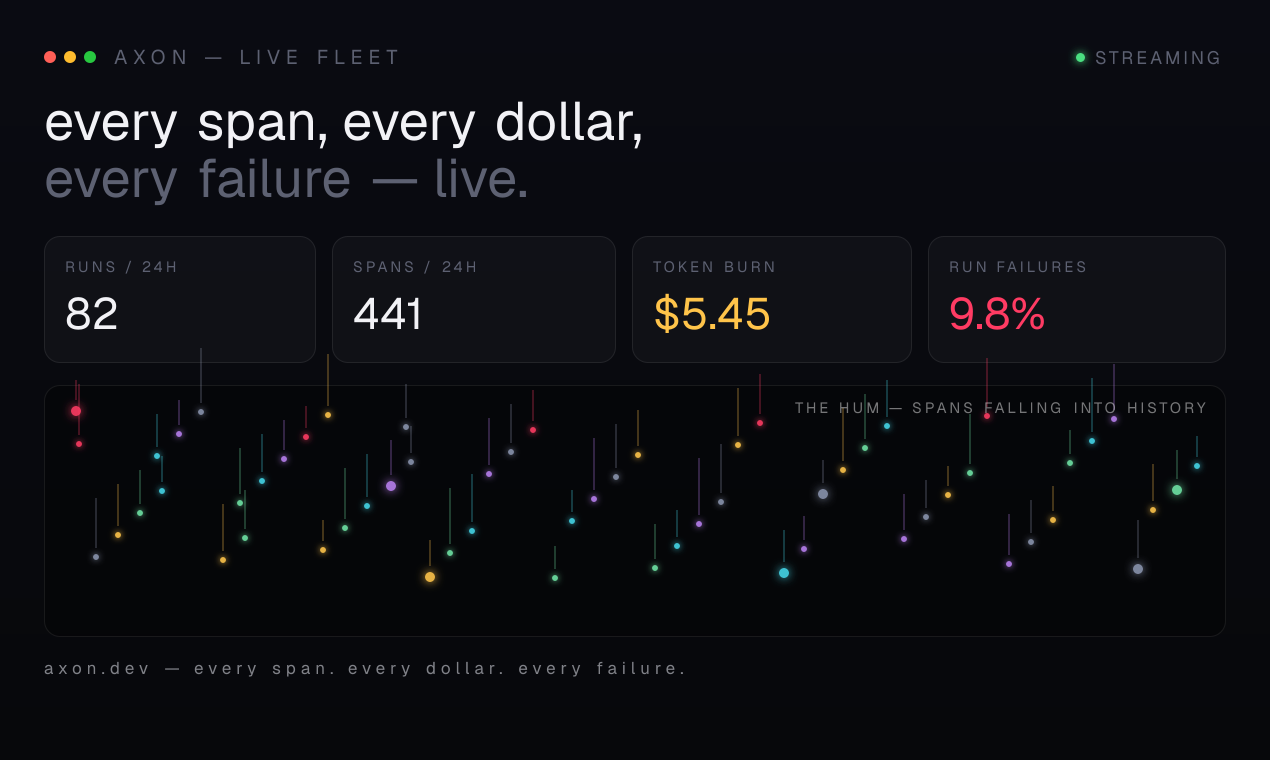
gallery-1-hum.png
1270 × 760 · hero: live dashboard + span rain (real 24h stats baked in)
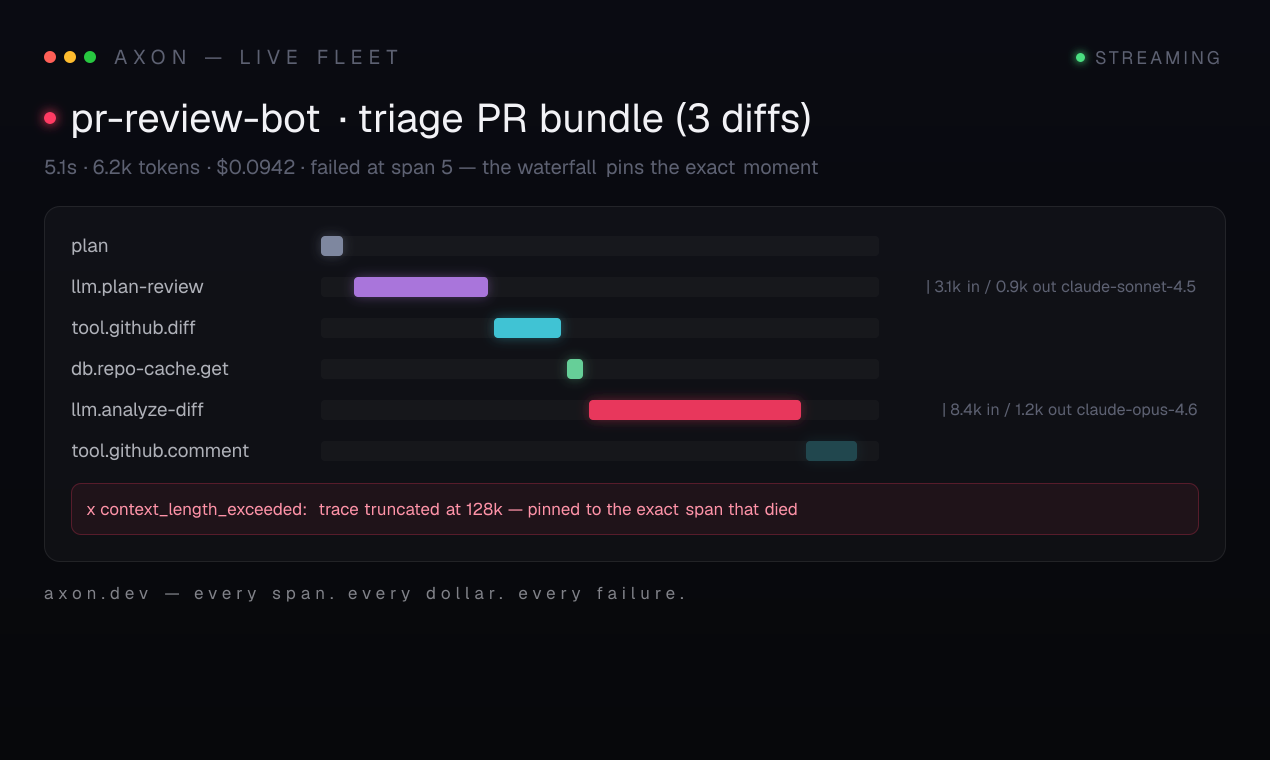
gallery-2-trace.png
1270 × 760 · the waterfall: failure pinned to the exact span
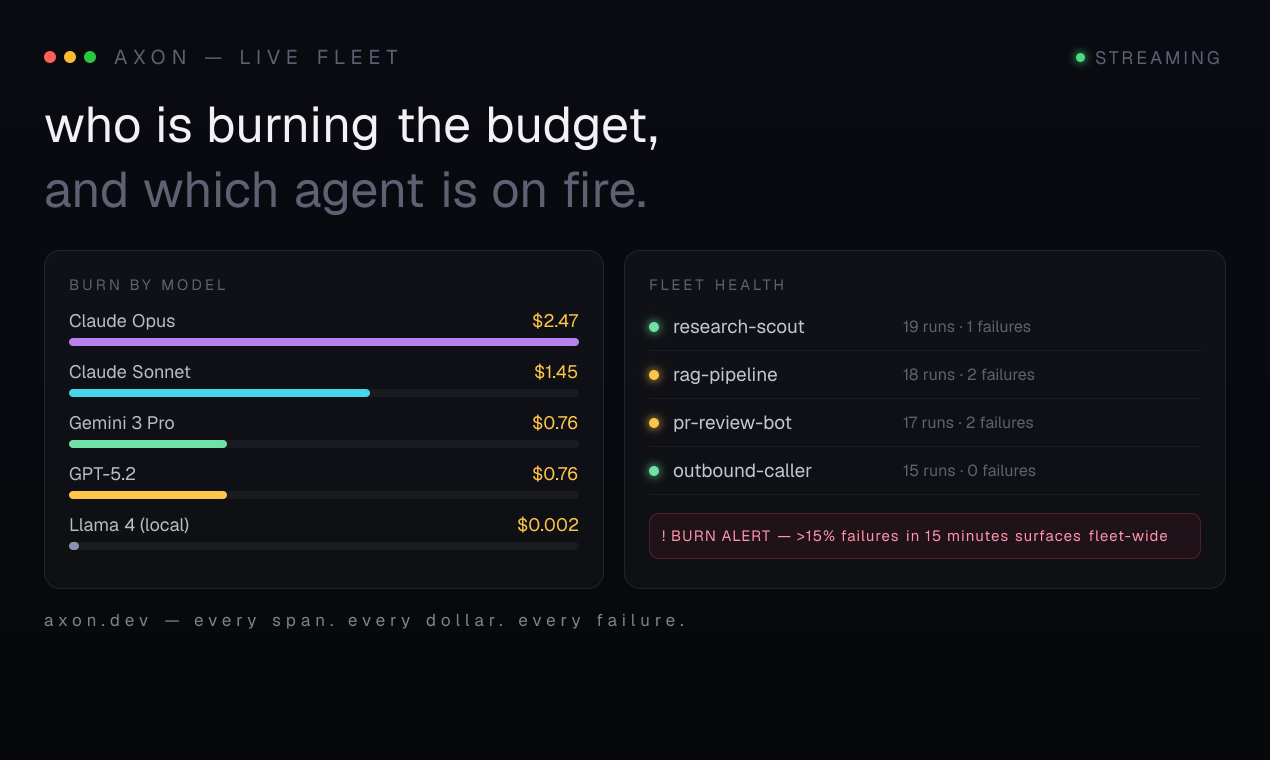
gallery-3-burn.png
1270 × 760 · model cost attribution + fleet health + burn alert
regenerate any time: /api/press?asset=logo|hum|trace|burn — the hum frame embeds live counts.
comment + social drafts
maker comment — post within 2 minutes of launch
Hey PH — maker here. I built AXON because my agent burned $311 overnight and my "observability" was an invoice. It's open, Postgres-native, and ingests plain JSON — no SDK, no signup. The dashboard on the page is live right now (simulated fleet, clearly labeled). Hit "run a simulated agent" and you'll watch a trace waterfall build itself. If you run agents in prod: what am I missing that would make you trust this with your fleet? Roast away — I'm here all day.
x / twitter post
my agent looped overnight and cost me $311 before coffee. so I built AXON — open observability for ai agents. one POST per span, no SDK. live waterfalls, per-model burn, 15-min failure flare. live on @ProductHunt now — page streams a labeled demo fleet. link below.
linkedin post
The infra mistake that cost me $311: trusting an autonomous agent without span-level telemetry. Today I'm launching AXON on Product Hunt — an open-source observability spine for AI agent fleets. One HTTP POST per operation (no SDK, no auth for the open tier), and every run becomes a live, inspectable waterfall with token cost attribution per model, latency percentiles, and a 15-minute burn-rate alert. Built for the agentic-coding era, self-hostable on Postgres, MIT-style freedom. The demo dashboard streams a labeled simulated fleet so you can judge it in ten seconds without installing anything. Would genuinely love the comment-section energy of people who run agents in production — link in comments.
launch-day battlefield plan
- T-2 weekstease on X/LinkedIn; collect waitlist; line up 15–25 genuine first-hour upvoters (real users, real comments — never bought votes).
- T-1 daythumbnail + 3 gallery frames from this kit. record a 30–45s screen capture: land page → press 'run a simulated agent' → waterfall builds live. that's the whole video.
- 00:01 PTsubmit. tagline from this kit, topics: Developer Tools, Artificial Intelligence, Open Source. post the maker comment within the first 2 minutes.
- first 2 hoursthe algorithmic window. wake your warm network; reply to every comment within minutes; keep one simulated agent running every minute so the page never looks dead.
- all dayanswer everything humbly; post the X/LinkedIn drafts at ~8am PT; evening update comment ('hours since launch, what broke, what we shipped').
- T+1 daypublish the postmortem blog — PH loves a numbered lesson list, and it feeds the second wave of traffic.
the optional video: loom screen-capture of the dashboard while a simulated agent runs — 45 seconds, no voiceover needed, the waterfall narrates itself.
axon press kit · assets live at /public/press · launch at 12:01am pt, tuesday–thursday